Jensen Huang has resigned from Nvidia. The bigger risk for Europe's AI plans is what Washington does next with the chips.
Nvidia's founder Jensen Huang resigned with immediate effect on 12 November, two weeks after reports linked him to a Megaspeed executive US officials believe works for Chinese intelligence. CFO Colette Kress is interim CEO. For European companies the leadership change matters less than the export rules Washington is now likely to tighten.
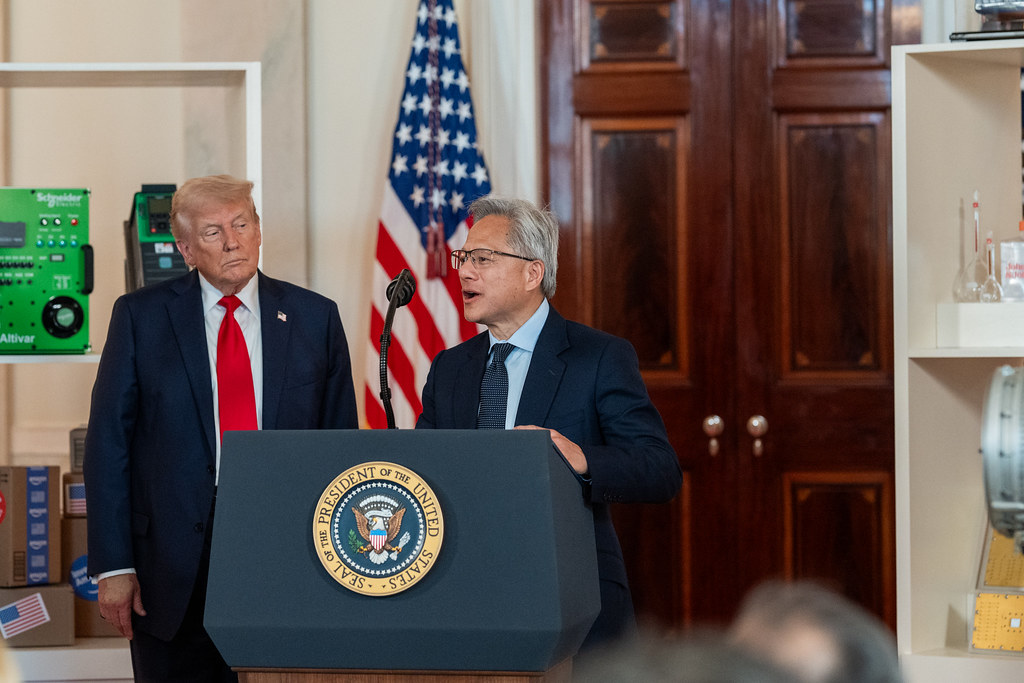

Jensen Huang has resigned as president, chief executive and board member of Nvidia with immediate effect, the company said on 12 November in a filing with the US Securities and Exchange Commission. Colette Kress, Nvidia’s chief financial officer since 2013, becomes interim CEO and keeps the finance job until a permanent successor is found. Harvey C. Jones, a director since 1993 and former chief executive of Synopsys, becomes Nvidia’s first independent chair. The board will look at internal and external candidates, and the results for the third quarter are still due on 17 November.
Huang co-founded Nvidia in 1993 and ran it for 33 years, taking it from graphics cards for gamers to the company that supplies most of the chips used to train and run AI. He resigned two weeks after the first report.
Why Jensen Huang left Nvidia
Huang left after reports that he had a close relationship with Alice Huang (no relation), an executive at Nvidia’s customer Megaspeed whom US intelligence agencies believe to be an asset of China’s Ministry of State Security. The New York Times first reported the relationship on 29 October, TechCrunch’s timeline shows. Nvidia’s spokesman said at the time that the contacts were “not unusual or unexpected”.
On 8 November Huang admitted in a letter to staff that he had been unfaithful to his wife and linked the matter to the national security concerns in the press. The board opened an independent investigation led by a committee of independent directors with outside counsel, and said it had no reason to believe the company’s secrets or national security had been compromised, CBS News reports. Then the reports kept coming. On 11 November the Times described a relationship with a senior Nvidia executive, which none of those involved have confirmed, and the Wall Street Journal reported that the board was preparing to remove him. He resigned the next day.
The allegations against Alice Huang have not been tested in court, and the evidence has not been made public. China’s foreign ministry called the spy story baseless, and Megaspeed denies wrongdoing.
What Megaspeed has to do with Nvidia’s chips
The national security question is about chips, and this is where the story touches every Nvidia customer. Megaspeed, a Singapore-based data centre company, is one of Nvidia’s biggest customers in Southeast Asia and bought more than $4.8 billion of Nvidia chips over two years, according to the Times as cited by CBS. A separate report citing Malaysian company records says a Megaspeed-linked company bought at least $4.8 billion of equipment built on Nvidia technology between June 2024 and February 2026, Gadget Review notes.
The United States and Singapore both confirmed investigations into Megaspeed over possible export violations in October 2025, and the Justice Department’s National Security Division is now investigating it, according to two law enforcement sources quoted by CBS. The Information has reported that Alice Huang and her family built a network of companies in China and Singapore that helped buy about $7.5 billion of Nvidia chips, some of them banned for export to China. Nvidia has said earlier smuggling allegations against Megaspeed were investigated and not substantiated.
None of this has produced charges. But the pattern US officials describe is familiar: chips bought legally by a cloud company outside China, then used by Chinese customers on site or rented out to them over the internet.
Why the export rules matter more than the CEO
Nvidia will survive without Huang. It has no close rival in AI chips, and an interim CEO who has presented its numbers on earnings calls for years. The shares fell as much as 13% at Thursday’s open before recovering part of the loss, and Nvidia’s market value dropped below $4 trillion, Yahoo Finance reports. Oppenheimer downgraded the stock, citing “massive shoes to fill and no obvious successor”. That is a problem for shareholders.
For customers, the export rules are the bigger issue. Huang was Nvidia’s most effective lobbyist in Washington, the man who called US export controls a failure in 2025. That argument has lost its spokesman at the moment Congress is most hostile. The Information reported this week that the White House may stop blocking two new sets of rules: one on Chinese companies reaching advanced AI chips remotely, and one on lithography tooling, possibly through the defence authorisation bill, Investing.com summarises. Senators Elizabeth Warren and Chris Coons have asked the administration to preserve records of Nvidia’s China dealings, and Democrats plan to investigate once they take control of Congress in 2027.
I expect the remote-access rule to pass in some form. The Megaspeed case is exactly the loophole it targets, and the political cost of opposing it has just gone up. It would not be aimed at Europe, but European cloud providers and anyone else who rents out Nvidia capacity would probably have to show who their customers are.
What it means for Danish and European AI infrastructure
Europe’s AI compute is built almost entirely on Nvidia, and much of it was negotiated with Huang personally. He switched on Denmark’s Gefion supercomputer with King Frederik X in Copenhagen in October 2024, a DGX SuperPOD with 1,528 H100 chips run by the Danish Centre for AI Innovation, Nvidia wrote at the time. The EU’s AI gigafactories, in which Denmark has committed up to DKK 750 million, assume a steady supply of the same chips. Nvidia also owns more of the software layer than it did a year ago, after buying Hugging Face.
Nothing in the SEC filing changes delivery schedules, and Jones promised operations and customer commitments would continue “without interruption”. The specialist GPU clouds took the hardest hit in the markets, among them Amsterdam-based Nebius. My reading is that investors are pricing in a supplier that will spend the next year answering to Congress and the Justice Department, and export checks that will get stricter.
There is a geopolitical layer as well. The incident channel the US and China opened in September left the chip war where it was. This affair moves it back to the centre of US politics, and when Washington tightens chip rules, Europe usually finds out from the fine print.
What European companies relying on Nvidia should check
If you buy GPU capacity from a cloud provider, ask where the chips sit and who else uses them. A provider that sells to customers in or linked to China could face new compliance work under a remote-access rule, and in the worst case lose access to new chips. Most European providers will pass easily, but you should know before your next contract renewal, not after.
If you are planning a large purchase of Nvidia hardware, expect more paperwork on end use, and build slack into the delivery timeline. Danish life science companies that use Gefion or plan to use the gigafactory capacity should ask their operators the same question.
And treat this as a reminder of supplier concentration. One company makes most of the chips your AI vendors depend on, and its founder was gone within two weeks of the first press report. That does not mean you can switch to AMD tomorrow. It does mean your AI suppliers should be able to tell you what happens to your service if Nvidia’s export situation changes, and you should ask them now.


